Tasks DB
Some operations take too long to finish within one HTTP request: installing a cluster's services, adding a node, placing a block, creating a vDAG, splitting a model. AIOS runs them in the background. The global Tasks DB lets you follow their progress.
At a glance
Runs on: the management cluster, as tasks-db-svc (NodePort 30108).
You'll use it to: check whether a long-running operation succeeded, using the task ID it returned.
How it works
sequenceDiagram
    participant U as You
    participant S as AIOS service
    participant T as Tasks DB
    U->>S: Start an operation (e.g. create-cluster-infra)
    S->>T: Create task (status: pending)
    S-->>U: Task ID (immediately)
    S->>S: Do the work in the background
    S->>T: Update status (completed / failed) and output
    U->>T: GET /task/<task_id>
T-->>U: Status and result- The service creates a task entry and returns its task ID straight away.
- It does the work in the background.
- When the work finishes or fails, it records the status and output in the Tasks DB.
- You look up the task by ID.
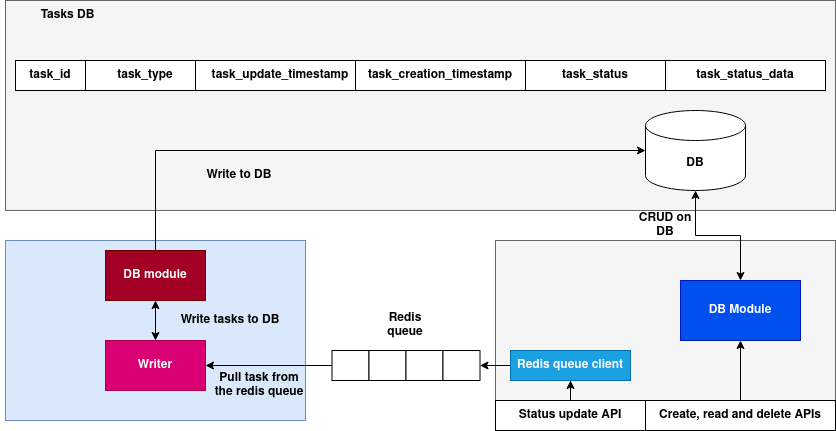
(Download the architecture diagram)
The writer and CRUD services can be scaled with load.
Task types
task_type |
Operation |
|---|---|
vdag_creation |
Creating a vDAG |
block_alloc |
Placing a block |
cluster_infra_creation |
Installing a cluster's AIOS services |
cluster_infra_remove |
Removing a cluster's AIOS services |
node_addition |
Adding a node to a cluster |
node_removal |
Removing a node from a cluster |
model_splits |
Running a model splitting job |
Task schema
@dataclass
class GlobalTask:
    task_id: str = field(default_factory=lambda: str(uuid.uuid4()))
    task_data: Dict[str, Any] = field(default_factory=dict)
    task_type: str = field(default_factory=str)
    task_update_timestamp: int = field(default_factory=lambda: int(datetime.utcnow().timestamp()))
    task_create_timestamp: int = field(default_factory=lambda: int(datetime.utcnow().timestamp()))
    task_status: str = field(default='pending')
    task_status_data: Dict[str, Any] = field(default_factory=dict)
| Field | Type | Description |
|---|---|---|
task_id |
str | Unique ID (UUID). |
task_data |
dict | The task's inputs and configuration. |
task_type |
str | The kind of operation (see Task types). |
task_create_timestamp |
int | When the task was created (UTC epoch seconds). |
task_update_timestamp |
int | When it was last updated (UTC epoch seconds). |
task_status |
str | pending (default), in_progress, completed or failed. |
task_status_data |
dict | Details about the status: results, progress or error messages. |
APIs
| Endpoint | Method | What it does | Typically used by |
|---|---|---|---|
/task/<task_id> |
GET |
Get a task. | You |
/tasks?task_type=...&task_status=... |
GET |
List tasks by type and, optionally, status. | You |
/task |
POST |
Create a task. | AIOS services |
/task/<task_id> |
PUT |
Update a task. | AIOS services |
/task/<task_id> |
DELETE |
Delete a task. | Admins |
/task_update |
POST |
Push a status update. Applied asynchronously, so it reaches the DB shortly afterwards. | AIOS services |
# Get a task
curl -X GET http://<server-url>/task/<task_id>

# List pending vDAG creation tasks
curl -X GET "http://<server-url>/tasks?task_type=vdag_creation&task_status=pending"

# Create a task (used internally)
curl -X POST http://<server-url>/task \
     -H "Content-Type: application/json" \
     -d '{
           "task_data": {"key": "value"},
           "task_type": "example_task_type",
           "task_status": "pending",
           "task_status_data": {"info": "status info"}
         }'

# Update a task (used internally)
curl -X PUT http://<server-url>/task/<task_id> \
     -H "Content-Type: application/json" \
     -d '{
           "task_data": {"updated_key": "updated_value"},
           "task_status": "in_progress"
         }'

# Delete a task
curl -X DELETE http://<server-url>/task/<task_id>

# Push a status update (used internally)
curl -X POST http://<server-url>/task_update \
     -H "Content-Type: application/json" \
     -d '{
           "task_id": "12345",
           "status": "completed",
           "task_status_data": {}
         }'
/task_update fields
| Field | Type | Required | Description |
|---|---|---|---|
task_id |
string | Yes | The task to update. |
status |
string | Yes | The new status. |
task_status_data |
object | No | Extra status details or output. |