Resource Allocator
The Resource Allocator runs resource allocation policies. Given a policy and some inputs, it gathers candidate clusters, their details and live metrics, runs your policy, and returns the best cluster, node and GPUs for a workload. It is generic: you plug in your own allocation logic.
At a glance
Runs on: the management cluster, as resource-allocator (WebSocket on port 8765, NodePort 30151).
Protocol: WebSocket, because answers can take a while when the search space is large.
Use it for: placement decisions and manual "where would this run?" dry runs.
How it works
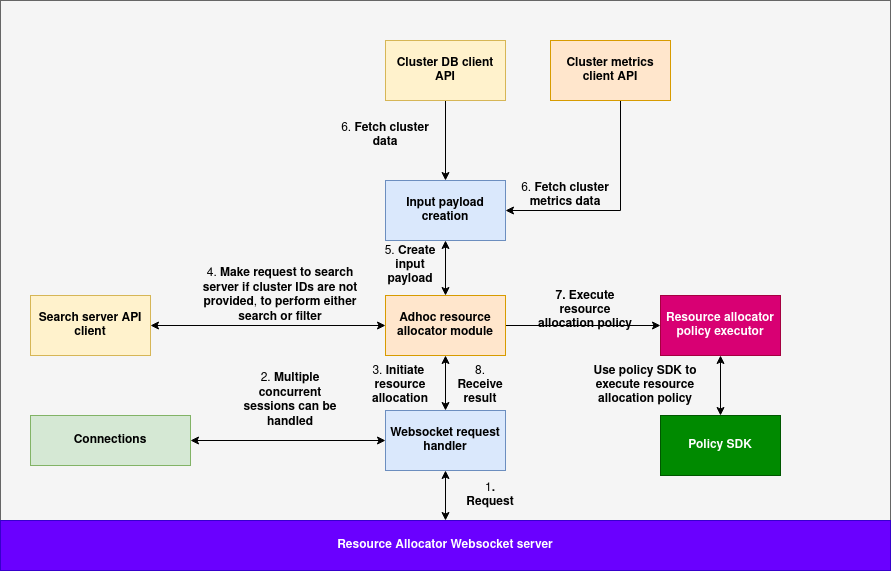
(Download the architecture diagram)
- A client sends a request over the WebSocket.
- If the request lists cluster IDs, those clusters are the candidates.
- If not, the request can include a filter or a similarity search query (see Search and filter).
- In that case, the Resource Allocator asks the search server for matching clusters.
- It fetches each candidate's record from the cluster registry, and its live metrics from the cluster metrics API.
- It loads your policy, giving it a cluster registry client and a cluster metrics client (see below).
- It runs the policy with the clusters' data and metrics.
- It returns the result over the WebSocket.
Send a request
Connect a WebSocket client and send one JSON message:
{
  "adhoc": true,
  "policy_rule_uri": "string",
  "clusters": [/* optional list of clusters */],
  "inputs": { /* required input parameters */ },
  "filter": { /* optional filter criteria */ },
  "search": { /* optional search criteria */ },
  "parameters": { /* optional parameters to customize allocation */ },
  "settings": { /* optional execution settings */ }
}
| Field | Type | Required | Description |
|---|---|---|---|
adhoc |
boolean | Yes | Must be true. |
policy_rule_uri |
string | Yes | The allocation policy to run (registered in the Policies System). |
clusters |
array | No | Candidate cluster IDs, if you already know them. |
filter |
object | No | A filter query to find candidates, if you don't. |
search |
object | No | A similarity search query to find candidates, if you don't. |
inputs |
object | Yes | Inputs for your policy, for example the workload's requirements. |
parameters |
object | No | Overrides for the policy's parameters. |
settings |
object | No | Overrides for the policy's settings. |
Python example
import asyncio
import websockets
import json
import logging

logging.basicConfig(level=logging.INFO)

async def send_resource_allocation_request():
    uri = "ws://<server-url>:8765"

    sample_payload = {
        "adhoc": True,
        "policy_rule_uri": "",
        "clusters": [],
        "inputs": {},
        "filter": {},
        "search": {},
        "parameters": {},
        "settings": {}
    }

    try:
        async with websockets.connect(uri) as websocket:
            # Send the request
            await websocket.send(json.dumps(sample_payload))
            logging.info("Request sent to server.")

            # Wait for the response
            response = await websocket.recv()
            logging.info(f"Response received: {response}")

    except Exception as e:
        logging.error(f"Error in WebSocket client: {e}")

if __name__ == "__main__":
    asyncio.run(send_resource_allocation_request())
Write an allocation policy
Your policy follows the standard policy structure. It does not need to implement management commands.
class AIOSv1PolicyRule:
    def __init__(self, rule_id, settings, parameters):
        """
        Initializes an AIOSv1PolicyRule instance.

        Args:
            rule_id (str): Unique identifier for the rule.
            settings (dict): Configuration settings for the rule
                (includes the injected clients; see below).
            parameters (dict): Parameters defining the rule's behavior.
        """
        self.rule_id = rule_id
        self.settings = settings
        self.parameters = parameters

    def eval(self, parameters, input_data, context):
        """
        Evaluates the policy rule.

        input_data = {
            "cluster_data": {<cluster_id>: {"data": ..., "cluster_metrics": ...}, ...},
            "inputs": <the "inputs" from the request>
        }

        Returns:
            dict: {"cluster_id": ..., "node_id": ..., "gpus": [...]}
        """
        # Allocation logic goes here
        return {}

    def management(self, action: str, data: dict) -> dict:
        """Management commands are not required for this policy."""
        return {}
Input
{
    "cluster_data": {<cluster_id>: {"data": ..., "cluster_metrics": ...}, ...},
    "inputs": <the "inputs" dict from the request>
}
cluster_data has one entry per candidate cluster:
{
    "cluster-0": {
        "data": <cluster-data>,
        "cluster_metrics": <cluster-metrics>
    },
    "cluster-1": {
        "data": <cluster-data>,
        "cluster_metrics": <cluster-metrics>
    }
}
| Key | Type | Description |
|---|---|---|
<cluster_id> |
string | One entry per candidate cluster. |
data |
dict | The cluster's record: hardware, labels, configuration. See Cluster registry. |
cluster_metrics |
dict | Live metrics: GPU availability, load, memory use. See Metrics system. |
Output
Example:
This means: use GPUs 0 and 2 on node-0 in cluster-123.
Clients available to your policy
The Resource Allocator adds two clients to your policy's settings:
settings.update({
    'cluster_client': self.cluster_client,
    'cluster_metrics_client': self.metrics_client
})
Use them like this:
# Cluster registry client
cluster_client = self.settings['cluster_client']
ok, cluster = cluster_client.read_cluster('cluster-123')

# Cluster metrics client
cluster_metrics_client = self.settings['cluster_metrics_client']
metrics = cluster_metrics_client.get_cluster('cluster-123')
| Client | Method | Returns |
|---|---|---|
cluster_client |
read_cluster(cluster_id) |
(True, record) or (False, error message) |
execute_query(query) |
(True, results) or (False, error message), for a MongoDB-style query |
|
cluster_metrics_client |
get_cluster(cluster_id) |
The cluster's metrics. |
query_clusters(query_params=None) |
Metrics for clusters matching a query. |
Client source
class ClusterClient:
    def __init__(self):
        self.base_url = os.getenv(
            "CLUSTER_SERVICE_URL", "http://<server-url>:3000")

    def read_cluster(self, cluster_id):
        try:
            response = requests.get(f"{self.base_url}/clusters/{cluster_id}")
            response.raise_for_status()
            return True, response.json()
        except requests.exceptions.HTTPError as http_err:
            return False, f"HTTP error occurred: {http_err}"
        except Exception as err:
            return False, f"Error occurred: {err}"

    def execute_query(self, query):
        try:
            response = requests.post(
                f"{self.base_url}/clusters/query", json={"query": query})
            response.raise_for_status()
            return True, response.json()
        except requests.exceptions.HTTPError as http_err:
            return False, f"HTTP error occurred: {http_err}"
        except Exception as err:
            return False, f"Error occurred: {err}"


class GlobalClusterMetricsClient:
    def __init__(self):
        self.base_url = os.getenv("GLOBAL_CLUSTER_METRICS_URL", "http://<server-url>:8888").rstrip('/')
        logger.info(
            f"GlobalClusterMetricsClient initialized with base URL: {self.base_url}")

    def _handle_response(self, response):
        try:
            response.raise_for_status()
            json_data = response.json()
            if not json_data.get("success", False):
                raise APIError(json_data.get(
                    "error", "Unknown error"), response.status_code)
            return json_data.get("data")
        except requests.RequestException as e:
            logger.error(f"HTTP error: {e}")
            raise
        except ValueError as e:
            logger.error(f"Invalid JSON response: {e}")
            raise

    def get_cluster(self, cluster_id):
        url = f"{self.base_url}/cluster/{cluster_id}"
        response = requests.get(url)
        return self._handle_response(response)

    def query_clusters(self, query_params=None):
        url = f"{self.base_url}/cluster/query"
        response = requests.get(url, params=query_params)
        return self._handle_response(response)
Related
- How blocks are placed during creation: Block spec: allocation flow
- Node and GPU allocation inside a cluster: Cluster Controller: resource allocation policy